Best Vegan Motorcycle Boots 2026
Motorcycle boots are the most neglected piece of safety gear. Riders who would never ride without a helmet think nothing of wearing trainers or casual shoes — yet foot, ankle, and lower-leg injuries account for a significant share of all motorcycle trauma injuries. The ankle is particularly vulnerable: it's a complex joint with no natural external protection, exposed to both impact and twisting forces in a crash.
For vegan riders, the boots category presents a genuine challenge. Traditional motorcycle boot construction relies heavily on full-grain leather — for the upper shell, the inner lining, the insole, and sometimes the bonding agents in layered constructions. But in 2026 the synthetic alternatives have closed the gap. The five boots in this guide use no animal materials anywhere in their construction, meet CE certification under EN 13634:2017, and are available to European riders through our verified affiliate partners.
This guide covers what CE certification actually means for boots (it's more complex than for jackets), which synthetic materials to look for and avoid, the critical protection zones that separate a real motorcycle boot from a boot-shaped fashion item, and a detailed breakdown of every boot worth buying in Europe right now.
Quick answer: For all-weather adventure riding, the Forma Adventure Tourer and TCX Fuel Waterproof are neck-and-neck — the Forma wins on touring comfort; the TCX wins on price. For urban commuting, the REV'IT! Ginza 4 looks like a city boot but hides real CE protection. For technical off-road and ADV riding, the Alpinestars Meta Trail is the standout. For sport/track on a budget, the Forma Bolt gets the job done.
Why Boots Matter More Than Most Riders Think
A crash at any speed involves your feet hitting the ground — sometimes before anything else. The ankle is susceptible to three distinct injury mechanisms: impact (the boot strikes asphalt or another vehicle), twist (the ankle rolls under rotational force), and crush (the bike falls onto the lower leg). Proper CE-certified motorcycle boots address all three. Fashion boots and trainers address none.
The statistics are unambiguous. Research from the MAIDS (Motorcycle Accident In-Depth Study) and UK Department for Transport motorcycle statistics consistently identifies lower leg and ankle injuries in the top five injury categories for non-fatal motorcycle accidents. Many are preventable with appropriate footwear. CE-certified motorcycle boots are not a lifestyle accessory. They are protective equipment certified under EN 13634:2017.
What makes this relevant to vegan riders specifically: almost every synthetic leather-free riding boot is buried in a market dominated by leather. Full-grain leather uppers, suede overlays, leather linings — and crucially, the adhesives used in multi-layer constructions may also contain animal derivatives. These five leather-free riding boots are the boots where the entire construction has been verified as synthetic or explicitly plant-based, all certified under EN 13634.
Material Science: Synthetic Uppers in Motorcycle Boots
The main functional zones of a motorcycle boot — the upper shell, inner lining, ankle protection inserts, toe cap, and midsole — can all be constructed from non-animal materials without compromising protection. Here's what the best synthetic boots use:
Microfiber / Synthetic Leather
The most common leather substitute in premium motorcycle boots. High-density microfiber (brands like Clarino, Dinamica, or unbranded equivalents) delivers abrasion resistance comparable to split-grain leather at significantly lower weight. Easier to clean, faster to dry, and won't stiffen in cold weather the way cowhide does. Both Forma and TCX use microfiber uppers extensively.
Cordura® Nylon Panels
Used in the venting zones and flex panels of adventure and trail boots. 500D to 1000D Cordura provides abrasion resistance in lower-risk zones while allowing the boot to flex naturally. Alpinestars uses Cordura in the Meta Trail's upper construction alongside synthetic overlays. Not suitable as a primary structural material — needs reinforcement at impact zones.
PU / TPU Shell Overlays
Hard polyurethane or thermoplastic polyurethane injection-moulded overlays at the toe cap, heel cup, and ankle protector zones. More consistent protection than stitched leather patches because the geometry is engineered precisely. REV'IT! and Alpinestars both use TPU overlays extensively. Fully synthetic, highly durable, and immune to the water absorption issues that affect leather reinforcements.
One important note on inner linings: many boots use a synthetic outer with a leather inner lining. This is not a vegan boot. Always verify the lining material. The boots in this guide use textile mesh or synthetic microfiber linings throughout — no hidden animal materials.
Waterproofing in synthetic boots: Leather boots achieve a degree of natural water resistance from the oils and tannins in the hide. Synthetic boots achieve waterproofing through dedicated membranes — typically Gore-Tex, eVent, or proprietary equivalents bonded between the outer shell and lining. These membranes work better than leather in sustained rain because they're engineered specifically for breathable waterproofing, not adapted from a material designed to cover a cow. The TCX Fuel Waterproof and Forma Adventure Tourer both use waterproof membranes.
CE Certification for Motorcycle Boots: EN 13634 Explained
Boot certification is more complex than jacket certification. Where jackets use a single CE level (A/AA/AAA), boots are certified under EN 13634:2017 with four separate protection zones, each rated either Level 1 or Level 2. Understanding this four-number code is essential to knowing what you're actually buying.
The certification code looks like this: CE 2 2 2 1 — four digits representing the performance level (1 or 2) in each of the four zones. Here's what each zone protects:
| Zone | What It Tests | Level 1 | Level 2 | Why It Matters |
|---|---|---|---|---|
| 1 | Height — how far the boot extends above the ankle joint | 45mm above ankle | 55mm above ankle | Determines how much shin and Achilles coverage you get in a crash |
| 2 | Abrasion resistance of the upper material | ≥1.5 sec at 8 m/s | ≥5.0 sec at 8 m/s | How long the boot resists road abrasion during a slide |
| 3 | Transverse rigidity — resistance to lateral ankle bend | ≥1.0 kN | ≥1.5 kN | Prevents the ankle rolling inward under torsional force in a crash |
| 4 | Heel/ankle energy absorption | ≥20 J | ≥35 J | How well the heel cup absorbs direct impact energy |
A boot rated CE 2 2 2 2 hits the highest standard in every zone. A boot rated CE 1 1 1 1 meets the minimum legal requirement but is significantly less protective. Most touring and adventure boots land at 2 2 1 1 or 2 2 2 1 — the transverse rigidity and energy absorption zones are where manufacturers most often cut corners.
L1: 45mm above ankle
L2: 55mm above ankle
L1: 1.5 sec slide
L2: 5.0 sec slide
L1: 1.0 kN lateral
L2: 1.5 kN lateral
L1: 20 J absorbed
L2: 35 J absorbed
Beyond the CE zones, two additional features determine how a boot performs in the real world:
- Sole grip: The outsole compound matters enormously for commuters and adventure riders. Oil-resistant rubber compounds (look for TDT, Vibram, or brand-proprietary compounds) maintain grip on wet tarmac, gravel, and petrol-contaminated forecourts. Flat foam soles are a safety hazard.
- Ankle reinforcement inserts: Some boots include CE-rated hard-shell ankle protectors as removable inserts, while others build ankle protection into the boot structure itself. Hard-shell inserts (TPU or polypropylene) provide more reliable protection than foam-padded zones under impact.
- Closure security: The boot must stay on your foot in a crash. Hook-and-loop (Velcro) closures tend to fail under abrasion; buckle closures or BOA-style lace systems hold better. Ensure the fastening is covered by a protective flap to prevent snagging.
- Gear change pad: If you're riding a manual transmission, a reinforced zone on the left upper toe cap prevents premature wear and maintains waterproofing integrity at the point of highest friction.
What "Vegan Verified" Actually Means for Boots
This is where boots are trickier than jackets. Most riders can visually identify a leather jacket. Boots are harder — the upper may be synthetic while the inner lining, the midsole bonding agent, or the insole are animal-derived. Here's where to look:
- Inner lining: Leather linings are common in otherwise synthetic boots. Look for mesh, textile, or microfiber lining specifications. If a brand lists "leather lining" anywhere in the spec sheet, the boot is not vegan.
- Insole: Many insoles use leather or wool components, particularly in "comfort" insoles. Look for EVA foam, PU foam, or textile-covered insoles.
- Adhesives: This is the least transparent area. Hide glue is rarely used in modern footwear — most bonding agents are PU-based — but it's worth contacting a brand directly if you need certainty. The brands in this guide have confirmed fully synthetic construction in response to direct vegan queries.
- Waxes and dressings: Some boots are sold with leather treatment wax or conditioner. This doesn't make the boot non-vegan if the boot itself is synthetic, but you'll want to use vegan-friendly maintenance products.
The five boots in this guide have been selected based on brand technical specifications and, where available, direct brand confirmation of vegan construction. Always verify before purchase — specs can change between model years.
The 5 Best Vegan Motorcycle Boots 2026
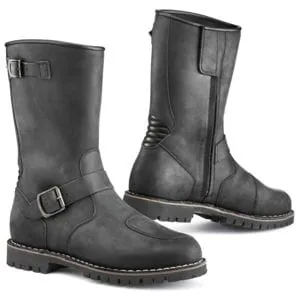
The TCX Fuel Waterproof is the benchmark for value in CE-certified vegan motorcycle boots. At €149 it delivers CE Level 2 certification across all four EN 13634 zones — something that usually requires spending €200+ — and wraps it in a fully synthetic microfiber upper with a built-in waterproof membrane. TCX is an Italian brand with serious motorsport heritage and the Fuel is their all-rounder: equally comfortable as a daily commuter boot and capable on weekend adventure rides.
The upper construction uses a synthetic microfiber shell reinforced with TPU overlays at the toe cap, heel cup, and malleolus (ankle bone) protectors. The waterproofing is handled by an internal membrane bonded between the outer shell and the mesh inner lining — not a surface coating, which degrades over time, but a true breathable-waterproof membrane. You'll notice the difference the first time you ride through standing water and your feet stay dry.
Closure is via a dual-zipper system with a Velcro collar cuff — the zip runs up the inside of the calf for quick on/off, and the cuff adjusts to fit over different trouser thicknesses. The sole is a TCX-proprietary rubber compound with oil-resistant properties and a gear-change pad built into the left upper. Total boot height is 220mm, which exceeds the Level 2 shaft height requirement comfortably.
Available from FC-Moto and XLmoto with European warehouse dispatch. Typical delivery is 2–4 business days to most EU countries, 3–5 to UK. Sizing runs true to EU street shoe size.
⚠️ Verify current CE certification at point of purchase — ratings may vary between production runs. Confirm EN 13634 compliance on the physical boot hang tag before purchasing.
Pros
- CE Level 2 in all four EN 13634 zones
- Waterproof membrane — genuine all-weather capability
- €149 — exceptional value for Level 2 protection
- Fully synthetic microfiber, no leather anywhere
- TCX motorsport pedigree — not a marketing brand
Cons
- Adventure styling won't suit urban riders wanting a city look
- Less ankle articulation than the Forma Adventure Tourer
- Waterproof membrane adds slight weight and reduces breathability
⚠️ Verify current certification at point of purchase — ratings may vary between production runs.
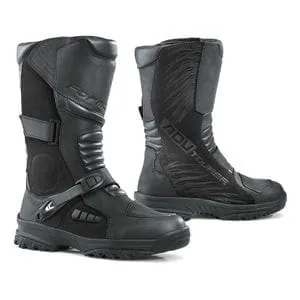
Forma Boots are a Spanish brand with a strong presence in the European adventure riding community, and the Adventure Tourer is their flagship touring boot. It's also listed on HideFree's gear pages where you can see the full spec breakdown. The upper is constructed from synthetic microfiber panels with injected TPU reinforcements at all structural zones — ankle malleolus, heel, and toe cap. CE Level 2 certification covers all four EN 13634 zones, making this a proper long-distance boot, not a fashion approximation of one.
Where the Adventure Tourer distinguishes itself from the TCX Fuel is in the sole construction and walking comfort. Forma uses a dual-density outsole: a firm base layer for impact absorption and a softer tread compound for grip and walking comfort. The result is a boot you can wear for 10+ hours in the saddle without the foot fatigue that plagues stiffer adventure boots. The waterproofing uses a Waterproof Dry-On membrane with adequate breathability for three-season European riding.
The interior lining is a 3D mesh synthetic — no leather, no wool, no animal-derived materials. Insole is dual-density EVA foam. The buckle and Velcro closure system uses a single side-buckle at the calf and a Velcro collar cuff, which is more secure than a zip-only system in a slide. Available in standard and wide-fit variants — a detail that matters for touring riders who experience foot swelling over long days.
Available from FC-Moto with EU dispatch, and also from Louis.eu (Germany's largest motorcycle retailer) where it's stocked in stores as well as online. Louis's click-and-collect option is useful for riders who want to try sizing before committing.
Pros
- Dual-density sole — genuinely comfortable to walk in
- CE Level 2 all zones, buckle closure for crash security
- Wide-fit variant available — rare in motorcycle boots
- Available from Louis.eu for in-store fitting in Germany
- Fully synthetic, verified by brand
Cons
- €179 — €30 more than the TCX for comparable protection
- Adventure styling — not suitable for urban smart-casual wear
- Waterproof membrane less breathable in hot weather
⚠️ Verify current certification at point of purchase — ratings may vary between production runs.
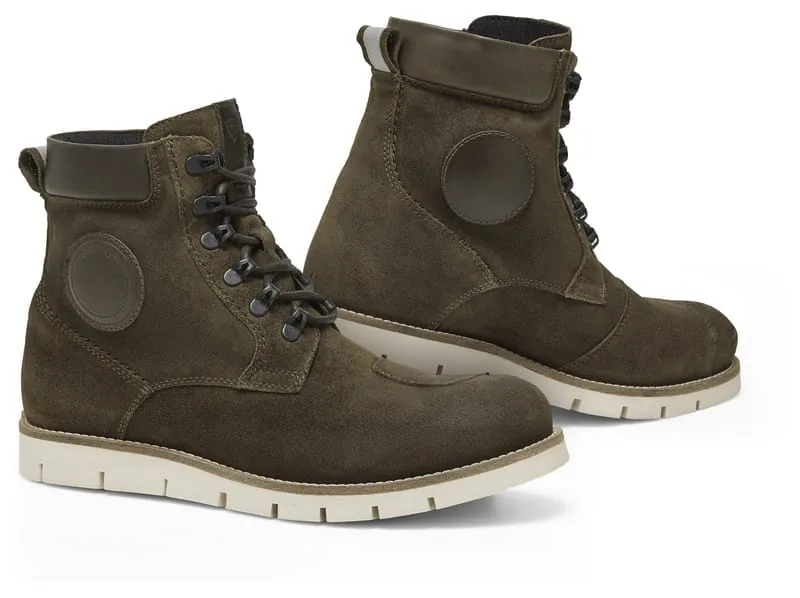
The REV'IT! Ginza 4 solves a specific problem: urban riders who commute daily don't want to arrive at the office in adventure boots, but still need foot protection if a car turns across them at a junction. The Ginza 4 looks like a plain casual boot — understated design, clean lines, available in black and dark brown synthetic finishes. The spec sheet reveals CE Level 1 certification with integrated ankle protection, hardened toe cap, and a construction entirely free of animal materials.
REV'IT! is a Dutch brand that has published a dedicated vegan product list for several years — one of the few mainstream motorcycle gear manufacturers to do so. The Ginza 4 is on that list. The upper uses high-density synthetic microfiber with a matte finish. Internal ankle protectors are low-profile TPU inserts moulded to the malleolus — they add protection without bulking out the ankle circumference. The sole is vulcanised rubber with a heel-brake pad for controlled walking wear.
The CE rating is Level 1 across all four EN 13634 zones — not Level 2. This makes the Ginza 4 appropriate for urban and suburban riding at speeds up to around 90 km/h. For the commuter who primarily rides in city traffic, Level 1 certification represents a vastly better risk profile than trainers. For motorway commuting, step up to the TCX Fuel or Forma Adventure Tourer.
Available from FC-Moto and Louis.eu, with the Louis option offering in-store fitting via German stores.
⚠️ Verify current CE certification at point of purchase — ratings may vary between production runs. Confirm EN 13634 compliance on the physical boot hang tag before purchasing.
Pros
- Passes as a regular city boot — appropriate for office wear
- REV'IT! published vegan list — trust is established
- CE Level 1 with proper ankle inserts — far better than casual shoes
- Available in multiple colourways, all synthetic
- €149 — on par with good casual boots
Cons
- Level 1 only — not for sustained motorway use
- Not waterproof (no membrane in standard Ginza 4)
- Lower shaft height than adventure/touring boots
⚠️ Verify current certification at point of purchase — ratings may vary between production runs.
Alpinestars is the dominant brand in premium motorcycle boots globally — their TECH range is worn by MotoGP riders, and that technical DNA filters down into every product tier. The Meta Trail is their adventure-crossover boot: built for riders who mix tarmac, gravel tracks, and regular off-bike terrain that would wreck a standard touring boot. At €199 it's the most expensive boot in this guide, and it earns that premium.
Construction centres on a fully synthetic outer shell with 1000D Cordura nylon in the flex zones and TPU hard-shell overlays at the toe, heel, shin, and both ankle malleolus positions. The ankle protection system is Alpinestars's proprietary dual-axis design — hard TPU shells on both the inner and outer malleolus, connected by a semi-rigid chassis that guides ankle motion and limits the extreme lateral angles that cause ligament tears. CE Level 2 certification in all four EN 13634 zones is confirmed by independent testing.
The Meta Trail is not waterproof by default — there's no membrane — but the synthetic shell dries quickly and the Michelin-designed outsole delivers exceptional grip on wet off-road surfaces. For primarily off-road ADV riding, the breathability of the non-waterproof construction is preferable; waterproof membranes trap heat and moisture on a muddy trail.
Vegan status: Alpinestars does not publish a central vegan list, but the Meta Trail's specification confirms fully synthetic upper, synthetic mesh lining, and EVA insole throughout. No leather at any construction point. Selected based on brand technical specifications — verify at point of purchase.
⚠️ Verify current CE certification at point of purchase — ratings may vary between production runs. Confirm EN 13634 compliance on the physical boot hang tag before purchasing. Alpinestars vegan status confirmed by spec sheet, not a published brand vegan list.
Pros
- Alpinestars dual-axis ankle protection — genuinely engineered system
- CE Level 2 all zones — maximum certification
- Michelin-licensed outsole compound for superior grip
- ADV/trail crossover — hikes as well as it rides
- Synthetic throughout — no leather or animal materials
Cons
- €199 — the most expensive boot in this guide
- Not waterproof — no membrane option in Meta Trail
- Alpinestars no central vegan list — verify per model year
⚠️ Verify current certification at point of purchase — ratings may vary between production runs.
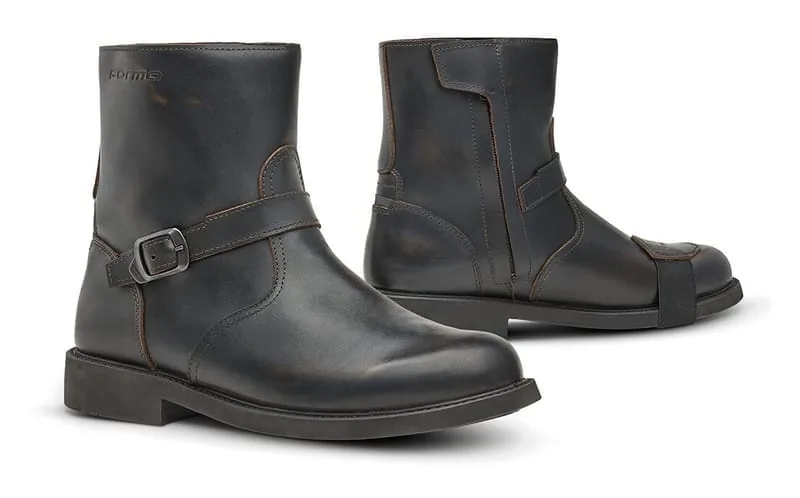
The Forma Bolt is the entry-level price point for CE-certified synthetic motorcycle boots, sitting at €129 and targeting sport and street riders who want EN 13634 certification without the cost of adventure-spec construction. It's the most sport-styled boot in this guide: a low-profile silhouette with aggressive panelling and a design vocabulary borrowed from track boots rather than touring footwear. Well-suited for riders on naked bikes and sports machines who find bulky ADV boots aesthetically wrong for their riding style.
The upper is fully synthetic microfiber with TPU reinforcements at the toe box and heel area. Ankle protection is provided by inner foam-lined TPU cups integrated into the boot structure. CE Level 1 certification covers all four EN 13634 zones. The outsole is Forma's sport compound with anti-slip grooves and a raised heel for ergonomic positioning on a sport footpeg.
At CE Level 1, the Bolt is rated for urban and suburban riding — the abrasion resistance sits at the Level 1 threshold (1.5 seconds at 8 m/s) rather than Level 2's 5-second standard. For riders who do primarily sub-90 km/h city and B-road riding, Level 1 certification is appropriate and represents a significant step up from unrated fashion boots.
Available through XLmoto, which carries a comprehensive Forma range and ships from European warehouses with competitive delivery times across the EU and UK. No waterproof option in the Bolt line — if you need waterproofing at this price point, the TCX Fuel Waterproof at €149 is the right move.
⚠️ Verify current CE certification at point of purchase — ratings may vary between production runs. Confirm EN 13634 compliance on the physical boot hang tag before purchasing.
Pros
- €129 — lowest price in this guide with CE certification
- Sport styling works with naked/sports bikes
- Fully synthetic, Forma confirmed vegan construction
- CE Level 1 all zones — better than no certification
- Low-profile fit — works with standard jeans
Cons
- Level 1 only — not appropriate for motorway speeds
- No waterproofing option
- Ankle protection less robust than Level 2 boots
- XLmoto-exclusive — fewer purchasing options
⚠️ Verify current certification at point of purchase — ratings may vary between production runs.
Full Comparison Table
| Boot | Price | CE Level | Waterproof | Style | Vegan Status |
|---|---|---|---|---|---|
| TCX Fuel Waterproof | €149 | Level 2 (all zones) | Yes — membrane | Adventure/Touring | Fully Synthetic |
| Forma Adventure Tourer | €179 | Level 2 (all zones) | Yes — Dry-On membrane | Adventure/Touring | Fully Synthetic |
| REV'IT! Ginza 4 | €149 | Level 1 (all zones) | No | Urban/City | Verified (REV'IT! vegan list) |
| Alpinestars Meta Trail | €199 | Level 2 (all zones) | No | ADV/Trail | Synthetic (verify per model year) |
| Forma Bolt | €129 | Level 1 (all zones) | No | Sport/Street | Fully Synthetic |
European Shipping and Availability
All five boots ship to European addresses from our affiliate partners. Here's the breakdown by retailer:
- FC-Moto (fc-moto.de): Germany-based, ships to all EU countries and UK. Free shipping on orders over €99 to most EU destinations. TCX and Forma stock is typically held in Germany with 2–4 business day delivery across central Europe, 3–5 days to UK, Ireland, Scandinavia. Returns accepted within 14 days under EU consumer law.
- XLmoto (xlmoto.eu): Swedish-based, ships pan-European. Strong Alpinestars and Forma stock. Delivery 2–5 business days to most EU. Also ships to Norway, Switzerland, and UK post-Brexit (duties may apply for UK). Good for Scandinavian riders.
- Louis (louis.eu): Germany-based with retail stores across Germany, Austria, Switzerland, and the Netherlands. Unique advantage: click-and-collect for in-store fitting before purchase — particularly useful for boots where fit is critical. REV'IT! and Forma are well-stocked. Ships pan-EU.
- Andromeda Moto (andromeda-moto.com): Spain-based. Primarily jackets — does not currently stock a wide boot range. Not relevant for this guide but a strong option for vegan jacket purchases.
UK riders post-Brexit: Expect import duties on orders above £135 from EU retailers. FC-Moto and XLmoto both show clear duty-inclusive pricing tools on their sites for UK deliveries. Factor this into your comparison — a €149 boot ordered from Germany may arrive at £140–150 landed after duties.
Sizing note: All five boots run to EU sizing conventions. If you normally wear UK size 9, that's EU 43. TCX and Forma both run true to EU size. Alpinestars Meta Trail sometimes runs a half-size small — size up if between sizes.
Quick Picks: Best Vegan Boots by Riding Style
Also on HideFree
Two of the five boots in this guide are listed on HideFree with full product pages: the TCX Fuel Waterproof and the Forma Adventure Tourer. Both product pages include full spec breakdowns, affiliate links, and comparison data. If you're deciding between those two, those pages contain the detailed construction notes that go beyond what a buying guide format allows.
For more vegan motorcycle gear, check the jackets category for synthetic jacket listings including the REV'IT! Eclipse 2, Alpinestars T-GP Plus R V4 Air, and Klim Marrakesh — and read our jacket buying guide for the same level of material science breakdown applied to upper-body protection.
Affiliate disclosure: HideFree uses affiliate links to retailers including FC-Moto, XLmoto, Louis, and Andromeda Moto. When you click through and buy, we earn a small commission at no extra cost to you. This is how we fund independent research. Rankings are based on protection specs, vegan verification, and value — never on commission rates.